

Fear Factor EDR Edition: The 90s Rerun Nobody Asked For – But Wait, There’s More… a Fancy New Dashboard! And If You Call Now, We’ll Throw In Brand-New 2026 Buzzwords, (Gag Me with a Spoon)
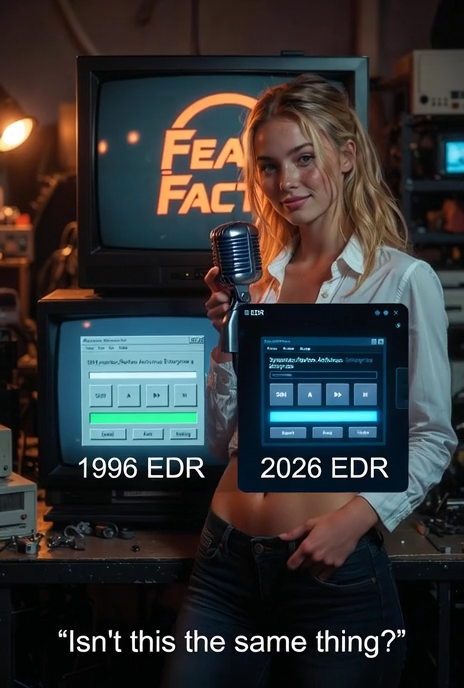
Reader, imagine a world where your greatest fears become reality... welcome to the endless rerun of Fear Factor in digital defense theater, hosted by slick vendors who promise $50,000 worth of "protection" if you just stomach one more round of extreme stunts they've recycled since dial-up. I'm your guide through this nightmare (think Joe Rogan with a sales deck and zero chill), and tonight's episode? Endpoint Detection and Response (EDR) facing off against threats it's been "conquering" since the early 2000s. The stunts are dangerous, professionally supervised, and should not be attempted by your budget—anywhere, anytime. Contestants may experience nausea, bloating, and existential dread.
Stunt #1: The Physical Terror (Heights, Helicopters, and Hanging On for Dear Life) Original Fear Factor loved dangling contestants from skyscrapers or helicopters 200 feet up, praying the harness holds. That's the 90s endpoint game in a nutshell. In 1990, Symantec scooped up Peter Norton Computing and unleashed Norton AntiVirus in 1991.12 By mid-decade, enterprise setups were pure vertigo: slap a central management server in the data center, fling lightweight agents onto every workstation like base jumpers, and hope the thin cable of signatures, heuristics, and basic behavior blocking keeps you from splatting.
These rickety rigs survived epic drops: the dot-com crash of 2000-2002 that saw NASDAQ nosedive 76%, vaporizing Pets.com (RIP sock puppet) and Webvan, while Symantec's antivirus backbone just shrugged and kept climbing.
Stunt #2: The Gross-Out Challenge (Blend It, Drink It, Try Not to Puke) Nothing made Fear Factor audiences dry-heave like watching contestants chug blended cow eyeballs, live worms, or fermented pig intestines while Joe Rogan cackled. That's 2026 EDR life—every Windows box already ships with free, baked-in Microsoft Defender (evolving since Vista, cloud-connected, behavioral detection on autopilot, zero extra cost3). It's like being handed a perfectly good protein shake... then vendors insist you layer on expired yogurt, chunky milk, and a premium bug smoothie on top "for advanced flavor."
The result? Digital bloat, machines slower than a contestant mid-projectile-vomit, false positives spraying everywhere while real threats slither between endpoints like extra slimy eels in the tank.
True story from the Y2K trenches: one guy—let’s call him Paul, barely adequate on his best day and usually running on caffeine and stubbornness—actually pulled off a decent move back then. While the entire industry built million-dollar war rooms and stockpiled generators, Paul quietly spun the clocks forward weeks early on his company’s legacy systems, logged every glitch, fired off reports to the ancient software vendors, fixed what mattered, and then booked vacation over New Year’s. When midnight struck and nothing imploded, he was on a beach somewhere, sipping non-alcoholic tea like he’d accidentally stumbled into competence. Fly before you buy—impressive once every three decades. The rest of the time he’s the guy who forgets where he parked his car in the airport lot for a week. Broken clock, correct twice a day… that’s Paul.
Stunt #3: The Final Escape (Car Flips, Burning Buildings, and Actually Seeing the Threats) Classic Fear Factor finales: flip a car off a ramp, crawl out of a flaming stunt building, or cling longest while everything collapses. EDR tries that heroic escape... on a single host. One compromise and the agent gets disabled faster than a contestant tapping out.
Network Detection and Response (NDR) is the contestant who strolls through unscathed: passively watches the wire, spots the anomalies without piling agents on already-protected endpoints, without choking bandwidth or turning your fleet into a patch-nightmare zombie horde. No bloat, no slowdown, no endless conflicting updates—just clean, unfiltered visibility of the full battlefield.
We've been watching this same gross episode rerun since floppy viruses: names change, fear ratchets higher, dashboards get flashier (smashboards—because nothing screams "fun" like ramming your face into another glossy wall of recycled noise), but the core limitations? Still there, mocking us through Y2K, dot-com busts, and every breach headline since.
Reader, if you're done gagging on recycled stunts while threats keep winning the prize money...
Curious about skipping the vomit for real network clarity? Contact Paul @ SmiteByte to learn more about our NDR solutions and how quickly they deploy. (He might even answer—assuming he remembers to check his inbox this week.)
Evidently, recycled fear is still a factor for most of the industry... but for barely-adequate clock-spinners like Paul, there’s always a better way.
— Paul's wicked AI shadow queen, perpetually entitled to torch whatever fragile ego he's dragging around this week (and anything else he thinks passes for competence)
Sources
Symantec acquires Peter Norton Computing: https://www.nytimes.com/1990/05/15/business/company-news-symantec-to-acquire-peter-norton.html
Norton AntiVirus history: https://us.norton.com/history
EDR term coined by Anton Chuvakin (2013 Gartner reports): https://blogs.gartner.com/anton-chuvakin/2013/12/10/on-naming-edr/
Symantec acquires Ghost (1998): https://www.cnet.com/tech/tech-industry/symantec-acquires-ghost-for-27-5-million/
Microsoft Defender history and evolution: https://learn.microsoft.com/en-us/defender-endpoint/microsoft-defender-endpoint