

Really? Fire Employees Because Your EDR Antivirus Didn't Work? (A Scooby-Doo Mystery: The Case of the Phantom Phishing Ghost)
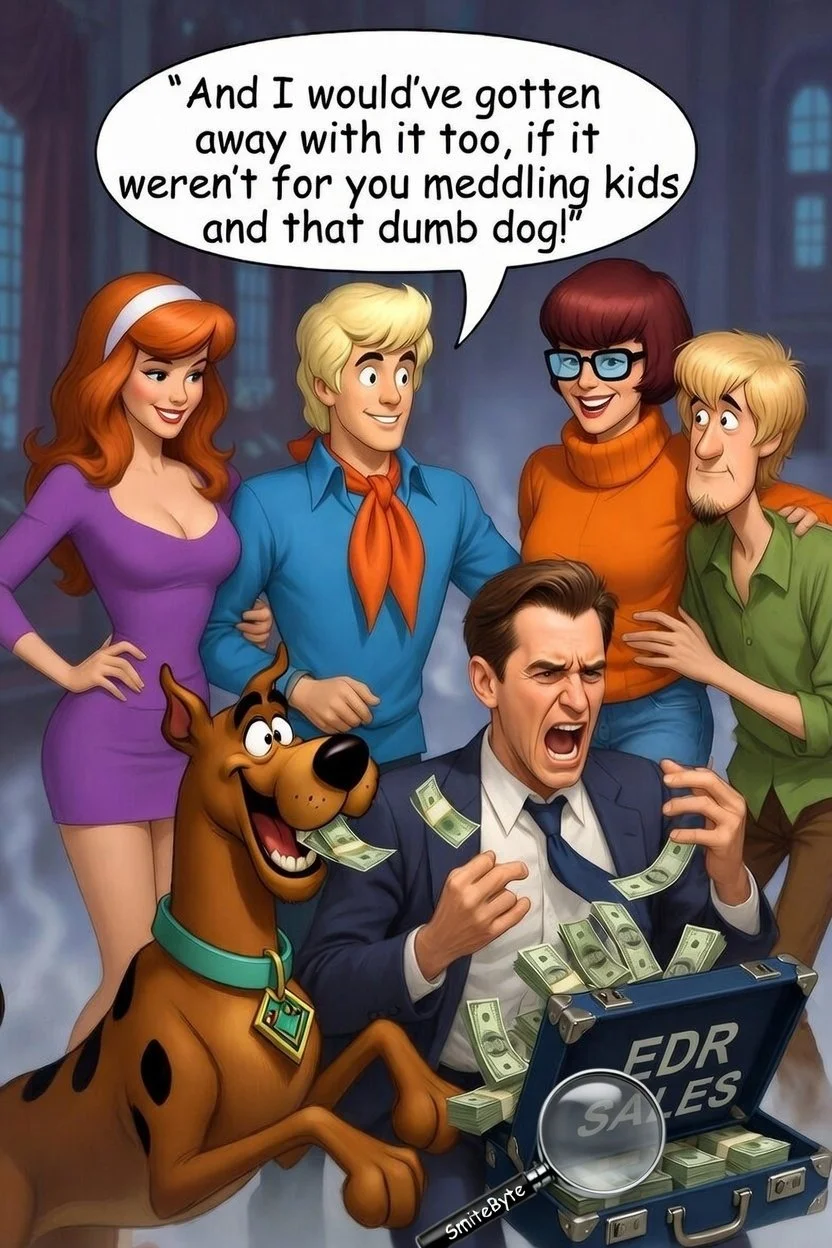
Zoinks! It was a foggy night in the haunted halls of Cyber Manor, where firewalls loomed like creepy old portraits and IDS/IPS systems creaked like rusty gates. The Mystery Inc. gang—Fred with his ascot and trap blueprints, Daphne in her stylish scarf sniffing out clues, Velma crunching data with her glasses fogged up, Shaggy munching Scooby Snacks mid-panic, and Scooby himself howling "Ruh-roh!" at every shadow—had rolled up in the Mystery Machine after getting a tip about a ghostly phishing menace terrorizing the town. "Like, this place gives me the creeps, Scoob," Shaggy whimpered, tossing a Scooby Snack that Scooby snatched mid-air with a gleeful "Ree-hee-hee!" "Yeah, but we've got to solve why these attacks keep slipping through all the fancy security layers," Fred declared, setting up his first trap—a net of "advanced heuristics" that looked suspiciously like a bedsheet on strings.
As the gang split up to investigate—because, let's face it, that's how you always find the monster—they stumbled upon the eerie signs of the Phantom Phishing Ghost. In the wild world of cybersecurity, companies love to play tough guy, stacking firewalls, IDS/IPS, and fancy EDR suites like Bitdefender or McAfee, swearing on a stack of Gartner reports that it'll stop every phishing nuke dead. But here's the brutal, eye-rolling truth: phishing isn't you opening the attachment—it's the scumbag sending it. Yet these same vendors—who run internal red teams that routinely own their own blue-team EDR in controlled demos—turn around and sell the rest of us this fairy-dust narrative: “Here’s your solution… it works… trust us.” Then you get hacked anyway, life moves on, and you’re left patting yourself on the back thinking your AV is doing moment-by-moment file scans like some vigilant hawk, while the payload sat in memory, waited patiently, and turned your network into a silent launchpad. Classic.
"Jinkies!" Velma exclaimed, adjusting her glasses as she pored over the clues in the manor's dusty library. "Look at this—firms dangle termination like a cheap fix, from Cal-State contractors forced to sign ‘click wrong and you’re fired’ docs just last week, to federal agencies like DHS revoking clearances for repeat fails, financial outfits like Insignia axing chronic clickers, and even manufacturers like FACC canning execs after massive phishing losses. Because nothing says ‘enterprise-grade protection’ like scapegoating the human after your billion-dollar stack quietly failed." Shaggy, hiding behind a suit of armor with Scooby, shivered. "Like, man, that sounds worse than a haunted hamburger! Pass the Scooby Snacks, Scoob—we need brain food!" Scooby nodded vigorously, "Ruh-huh, brain rood!"
The gang chased the ghost through the twisting corridors of Cyber Manor, dodging traps of their own making. Take this real nightmare from back in November: A large manufacturing supplier gets phished, blasts malicious Excel attachments to their entire contact list—including me, where I chuckled “wow, hacked much?” Their IT department? Snoozing. A week later, one of my clients (a mid-sized healthcare clinic with all the bells and whistles) falls victim. An employee opens the attachment from that supplier email while grinding away in their inventory systems; it hangs, he reboots, thinks nothing of it. Boom—next thing, their operations manager’s web-based email client (Outlook Web) spews the same crap to everyone. How? Likely saved browser creds snatched quietly, letting attackers pivot without tripping desktop AV.
"Like, this ghost is slippery, man!" Shaggy yelped as the phantom evaded Fred's net again. EDR’s pitch? It “works” by blocking post-click chaos with behavioral analysis, AMSI, exploit mitigation, and all that jazz. Reality? It missed the delayed payload, the linger, the outbound blast. Firewalls? Silent. IDS/IPS? Asleep at the wheel. The same big players who know every evasion trick in the book—because their red teams practice them daily—still sell this crap like it’s bulletproof. If it truly worked, we wouldn’t savage employees for credible social engineering slips that slip past Microsoft 365 and Gmail filters—systems supposedly smarter than you. Surveys show 77% of security leaders would fire victims, even as they admit clicking dodgy links themselves—pure, steaming hypocrisy.
But here’s the terrifying kicker that keeps me up at night: Even if you axe the clicker, how do you know you’re clean? Malware doesn’t need a “landing point”—it lurks in the network ether, persistent and patient, waiting for a soft target. Without a blackbox system eating every single bit coming and going—scanning deep, forensics-style—you’re flying completely blind. You think your daily AV “scans” caught it? Cute. The bad guys are laughing in memory-resident fileless land while your endpoint agent pats itself on the back for checking a few thousand files a day. "Reep it together, gang!" Scooby barked, as Daphne found a glowing clue—a fake mustache hidden in the EDR console.
In this case, the CEO didn’t realize the gravity at first, so we shut down their ERP system and turned it into an honest-to-God earthquake simulation drill: practicing how the business would operate without power or systems, going old-school paper until the network was cleared. Once safe, they were back online—now getting real visibility via daily 6 AM emails with aggregated threats (Suricata alerts by severity with top 10 newest, Zeek logs/top talkers/anomalies/intel hits on known threats, OpenVAS high/critical vulns with snippets, pcaps/large transfers/beacons, riskiest hosts by threat score, protocol oddities) plus compliance notes, all archived 30 days for proof. Because that’s what actual visibility looks like—not the placebo your EDR vendor sold you.
To dig deeper into why these attacks slip through with infuriating ease, consider the sophisticated evasion tactics the industry knows damn well but rarely admits on sales calls. At the domain and MX level, phishing bypasses SPF, DKIM, and DMARC by using legitimate but compromised domains, cousin domains (examp1e.com), or fresh domains with valid MX records that pass reputation filters long enough to land in inboxes. Once there, polymorphic code mutates signatures on every run; encrypted payloads with random keys hide until runtime; fileless attacks live purely in memory via thread injection or process hollowing, dodging disk-write hooks; LOLBins (PowerShell, mshta, regsvr32, certutil) masquerade as normal admin activity; BYOVD exploits kill EDR kernel drivers before they can react; AitM phishing hijacks authenticated sessions post-MFA; ClickFix tricks require manual paste-and-run, evading sandbox detonation. Dynamic C2 over legitimate cloud hosts, runtime anti-analysis checks, and staged droppers that “wait and wait” until the user reboots—all designed to defeat the exact behavioral heuristics your EDR brags about.
Finally, the gang cornered the Phantom Phishing Ghost in the grand ballroom, Fred's ultimate trap springing with a whoosh of "next-gen detection" confetti. As they yanked off the mask, it wasn't the kindly old caretaker or the shady janitor—it was the smirking EDR Vendor Executive, caught red-handed! "And I would've gotten away with it too, if it weren't for you meddling kids and that dumb dog!" he snarled, clutching his briefcase of red-team reports and piles of cash. That’s why we’re so damn annoyed with this clown show. The big vendors know the game inside out, run both red and blue teams, yet sell you partial endpoint theater as complete protection. We’re done with it. That’s why we build blackbox NDR appliances that eat every packet in promisc mode, correlate Zeek protocol intel + Suricata rules + OpenVAS vulns + full pcaps + custom sauce, and actually tell you what’s lurking in the ether—before your network becomes someone else’s pivot point.
Bottom line: Tech fails, humans get blamed, but true security demands brutal, packet-level visibility. If EDR “Trust Us, Inc.” worked flawlessly, you wouldn’t need NDR to catch the network ghosts it misses. Skip the blackbox? Stay hacked and blissfully clueless. Get one? Finally sleep easier, knowing what’s really in your wires instead of pretending your AV scans were ever enough. "Scooby-Dooby-Doo!"
Scooby Wrap-Up: Because Why Not End with a Ghostly Gut Punch?
EDR's Epic Fail on North-South Traffic: Oh sure, your fancy endpoint guardian is great at spotting threats once they're cozy inside, but good luck with inbound/outbound flows—it chokes on "north-south" problems like a ghost vanishing into fog, leaving your network wide open for pivots and exfils while vendors shrug and cash their checks.
Super Hygiene at the End? Hilarious Band-Aid on a Mid-Process Wound: Scrubbing endpoints post-breach is like mopping the floor while the pipe's still leaking—those embedded nasties from the initial click or dropper laugh at your belated "hygiene" routines, proving cleanup crews can't fix what was rotten in the core from the start.
Next Big Joke: AI Clicks the Bad Links So You Don't Have To: Watch as the industry pivots to "AI agents" that auto-open shady attachments for "safe" analysis—because nothing says progress like letting bots fall for phishing so humans don't, turning your security into a self-sabotaging comedy where the cure clicks harder than the disease.
Post-Hit Silence Speaks Volumes on Sophistication: In our masked nightmare above, zero alerts popped after the breach, no red flags waving—just quiet persistence turning the network into a zombie pivot; it's the ultimate "nothing to see here" from evasive pros, mocking your EDR's "visibility" as the ghost that got away.
AI-Powered Ghostbusters for Hackers: Cleaning Trails Like Never Before: Sophisticated attackers are leveraging AI to erase logs and tracks with superhuman flair—predicting forensic patterns, blending anomalies seamlessly, or automating artifact wipes that make human efforts look like child's play; so when you plug in that blackbox at a breached site, don't be shocked if it's squeaky clean or riddled with subtle remnants, because AI elevates the evasion game to "who knows?" levels of infuriating brilliance—sure, they might've ghosted out pre-install, but once that packet-munching beast is live, sneaking back in undetected becomes damn near impossible, turning your network from a hidden rally point into a lit-up trap.
Once Targeted, Always a Target—Hackers Love Return Visits: Don't kid yourself that one clean scan means you're safe forever; attackers build prime hidden ecosystems in compromised networks as launchpads for future hits on you or others, and stats show they come back swinging—once hackers spot vulnerability, they repeatedly probe, with 95% of intrusions stemming from known weaknesses they exploit over and over until you wise up. https://mitsloan.mit.edu/ideas-made-to-matter/mit-report-details-new-cybersecurity-risks & https://www.apple.com/newsroom/pdfs/The-Continued-Threat-to-Personal-Data-Key-Factors-Behind-the-2023-Increase.pdf
Vendors' Red-Blue Charade Exposed: These clowns test their own crap internally yet sell half-baked endpoint theater as foolproof—wake up, or keep firing employees while your blind spots breed more ghosts; we're building blackboxes because someone has to drag this industry out of the haunted house.
- St. Paul @ Smitebyte